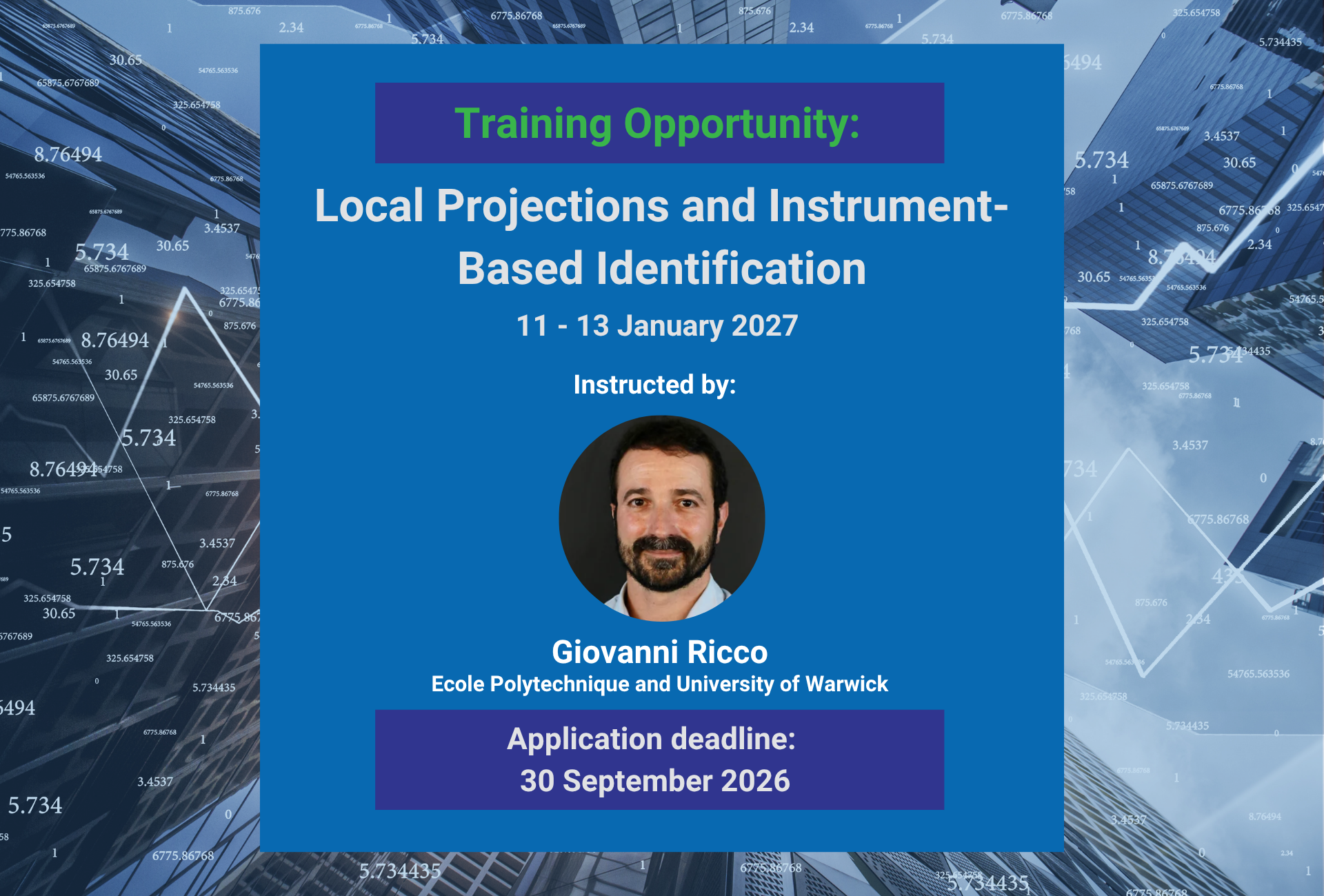
Course overview
This 3-day course offers a rigorous and practical treatment of local projection methods: their statistical properties, how they compare with vector autoregressions, and the instrument-based identification strategies that have reshaped the measurement of monetary policy shocks in policy institutions and in academic research.
Participants will learn when VARs and local projections deliver the same dynamic causal effects and when they do not, how to choose between them, and how to construct, validate, and deploy instruments for monetary policy and other shocks from high-frequency asset price surprises and narrative records.
Each day combines three to four hours of theory and close reading of key contributions in the literature with a one- to two-hour hands-on session implementing a selection of the methods discussed.
The course draws mainly on recent published articles and working papers.
Course outline
Day 1: From vector autoregressions to local projections: Vector autoregressive models and local projections; Direct versus iterative forecasts; VAR and multivariate direct forecast; Structural shocks and the Frisch–Slutsky paradigm; SVMA, Wold decomposition, and VARs; IRFs from VARs and local projections; Do VARs and LPs estimate the same IRFs?
Day 2: Finite-sample properties, extensions, and regularised LPs: Monte Carlo evidence; Small-sample bias; Are local projections robust to misspecification? Bias-variance trade-off, Local projections or VARs? State-dependent LPs; Panel local projections; Bayesian inference; Bayesian regressions and BVARs; Bayesian local projections; Smooth LPs.
Day 3: Identification, invertibility, and instrumental variables: The problem of identification; Statistical identification; IV methods in macro; Conditions for valid IV identification in LPs and VARs; Identification under partial invertibility, recoverability, and non-recoverability; Narrative and high-frequency identification; IVs for monetary policy shocks; External and internal instruments.
Facilitator
Giovani Ricco is Professor of Economics at the Ecole Polytechnique and at the University of Warwick, a Chercheur Associa at OFCE-SciencesPo, and a CEPR Research Fellow. He holds a Ph.D. in Economics from the London Business School and a Ph.D. in Physics from the University of Pisa. His main research interests lie in the fields of empirical macroeconomics and time-series econometrics.
Target Participants
The workshop is intended for PhD candidates, postdoctoral researchers, early-career academics, and research professionals at central banks and related policy institutions. Advanced Master’s students with strong quantitative backgrounds may also be considered.
Applicants should have:
- Prior graduate-level exposure to time series econometrics.
- Working familiarity with Matlab or similar software (Matlab will be used in workshop exercises).
- A research interest in empirical macroeconomics or central bank policy analysis.
Application Process and Requirements
Applications must be submitted by 30 September 2026. Decisions will be communicated by 14 October 2026.
Funding and logistics
ERSA will cover domestic travel within South Africa and accommodation for participants based at South African institutions for the duration of the course.
Places are limited to 20 participants. Funding and participation decisions remain at the discretion of the organisers.
The 5th ASB/Banco Central de Chile/CEPR/ERSA Workshop on Macroeconomic Policy in Emerging Markets will be held in Pretoria during the two days immediately following the course. Participants are encouraged to remain in Pretoria and attend the workshop. ERSA will cover conference registration/attendance but will not cover the additional accommodation or other costs associated with extending the stay beyond the course.
Contact
For more information and registration details, please contact Fouché Venter.