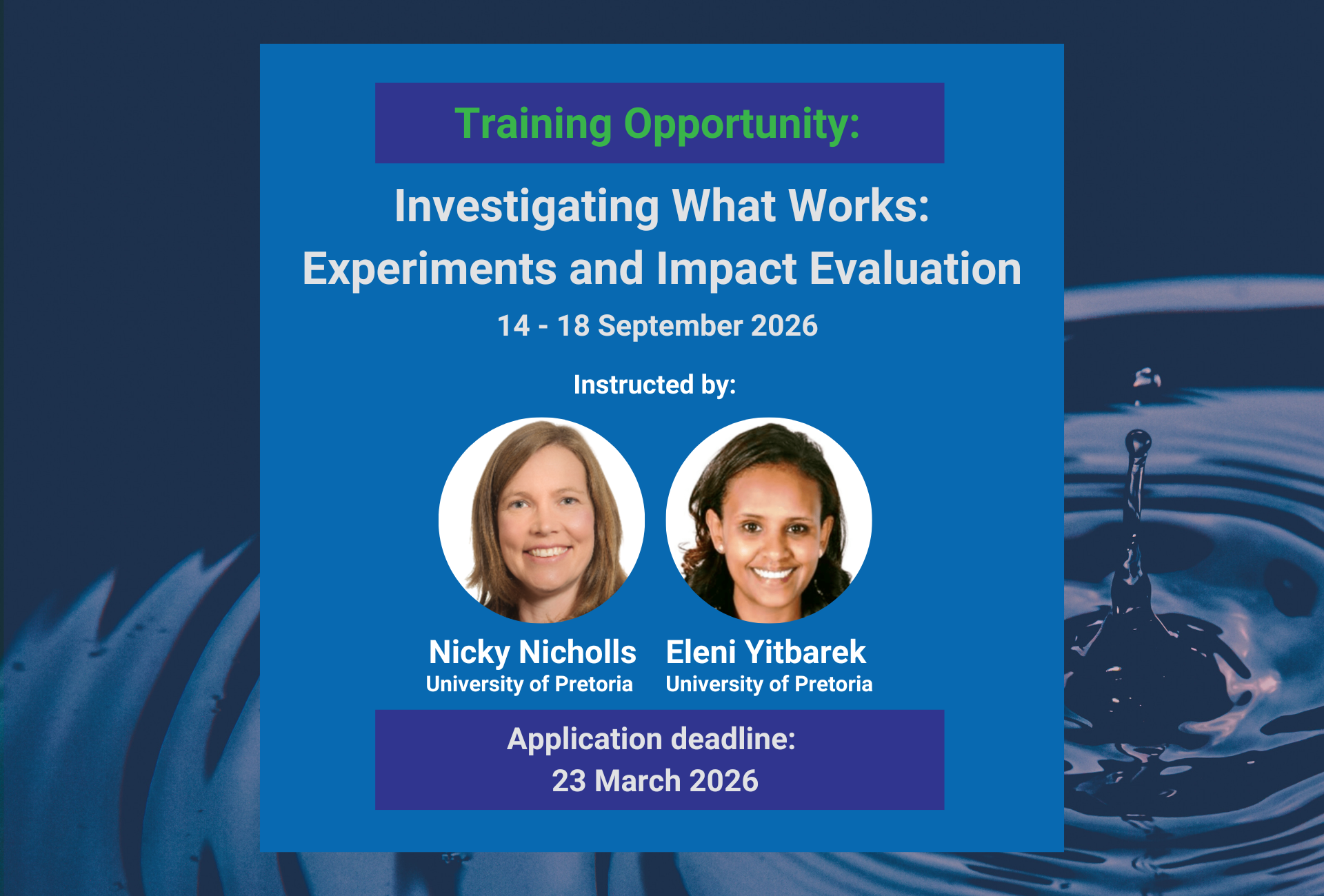
Economic Research Southern Africa (ERSA) invites applications for a five-day intensive skills workshop on behavioural economics and impact evaluation. The course focuses on practical methods for evaluating the success of interventions, either by testing prior to roll-out, or by investigating impact post roll-out.
Course overview
This short course introduces participants to two complementary approaches for evaluating the effectiveness of development interventions: experiments, including Randomised Controlled Trials (RCTs), and impact evaluation methods used when experimental approaches are not feasible. Drawing on behavioural economics and applied development economics, the course equips participants with the conceptual tools needed to design credible evaluations and to interpret empirical evidence for policy. The emphasis throughout is on understanding what works, why it works, and how rigorous evidence can inform effective development policy.
Course outline
Over the course of five days, the workshop progresses from the design and implementation of experiments to econometric approaches for impact evaluation when randomisation is not possible. In the first part of the course, participants engage with core principles from behavioural economics and experimental design, working through applied examples and established experimental tasks to study social and behavioural preferences. Hands-on sessions focus on identifying policy-relevant questions, designing experiments, and refining proposed designs through in-class implementation, peer feedback, and discussion.
The second part of the course focuses on impact evaluation using quasi-experimental methods commonly applied in development economics. Participants examine real-world policy evaluations related to poverty and inequality and learn how techniques such as Difference-in-Differences and Regression Discontinuity Designs can be used to estimate causal impacts. Practical sessions involve working with real policy, administrative, or survey data, with attention to identification assumptions, estimation, robustness, and interpretation of results for policy decision-making.
Instructors
Nicky Nicholls is an Associate Professor in the Department of Economics at the University of Pretoria. She is a behavioural economist with postgraduate qualifications in Psychology (MA) and Economics (PhD), and more than 20 years of experience working on surveys and experiments in both corporate and academic settings. Her research focuses on decision-making, including corruption, trust, fairness, and bias, and has been published in journals such as the Journal of Risk and Uncertainty, the Journal of Behavioral and Experimental Economics, and Economics Letters.
Eleni Yitbarek is an Associate Professor in the Department of Economics at the University of Pretoria, a Research Fellow with the Partnership for Economic Policy (PEP) and Economic Research Southern Africa (ERSA), and a member of the Academy of Science of South Africa’s Standing Committee on Science for the Reduction of Poverty and Inequality. She holds a PhD in Economics from Maastricht University. Her research focuses on poverty and inequality dynamics, intergenerational mobility, climate change vulnerability, and household risk-coping and behavioural responses. Her work has been published in leading peer-reviewed journals, including Economics Letters, Journal of Economic Behavior & Organization, Food Policy, Journal of Development Studies, and Journal of Behavioral and Experimental Economics. She has collaborated with international development organisations, including the World Bank, UNDP, UNCTAD, SNV, the European Investment Bank, the Global Development Network, and the African Climate Policy Centre.
Nicky Nicholls and Eleni Yitbarek are frequent research collaborators, with several joint publications.
Target Participants
The course is intended for participants with a strong background in economics (at least Honours level), including prior exposure to econometrics and experience using statistical software such as Stata. The course is particularly suited to students and researchers interested in applied economic analysis, programme evaluation, and evidence-based development policy.
Application Process and Requirements
Interested applicants must submit their application by 23 March 2026. Application decisions will be communicated by 6 April 2026.
ERSA will cover domestic travel (within South Africa) and accommodation costs for participants based at South African institutions. For students based in outside of South Africa, ERSA will cover accommodation and domestic travel within South Africa, while international flights will be the responsibility of the participant.
Places are limited to 25 participants, and funding to attend the workshop is entirely at the discretion of the organisers.
Contact
For more information and registration details, please contact Claudine Tshabalala.