CGE modelling is a challenging field. It requires mastery of economic theory, meticulous preparation of data and familiarity with underlying accounting conventions, knowledge of econometric methods, and an understanding of solution algorithms and associated software for solving large equation systems. However, the most important requirement is the ability to communicate. CGE modelling is primarily about shedding light on real-world policy issues. For CGE analyses to be influential, modellers must explain their results in a way that is comprehensible and convincing to their fellow economists, and eventually to policy makers.
While CGE modelling is challenging, it is also rewarding. CGE models are used in almost every part of the world to generate insights into the effects of policies and other shocks in the areas of trade, taxation, public expenditure, social security, demography, immigration, technology, labour markets, environment, resources, infrastructure and major-project expenditures, disasters, and financial crises. CGE modelling is the only practical way of quantifying these effects on industries, occupations, regions and socioeconomic groups.
Peter B. Dixon & Dale W. Jorgenson
Chapter 1 in Handbook of CGE Modeling
Course Overview
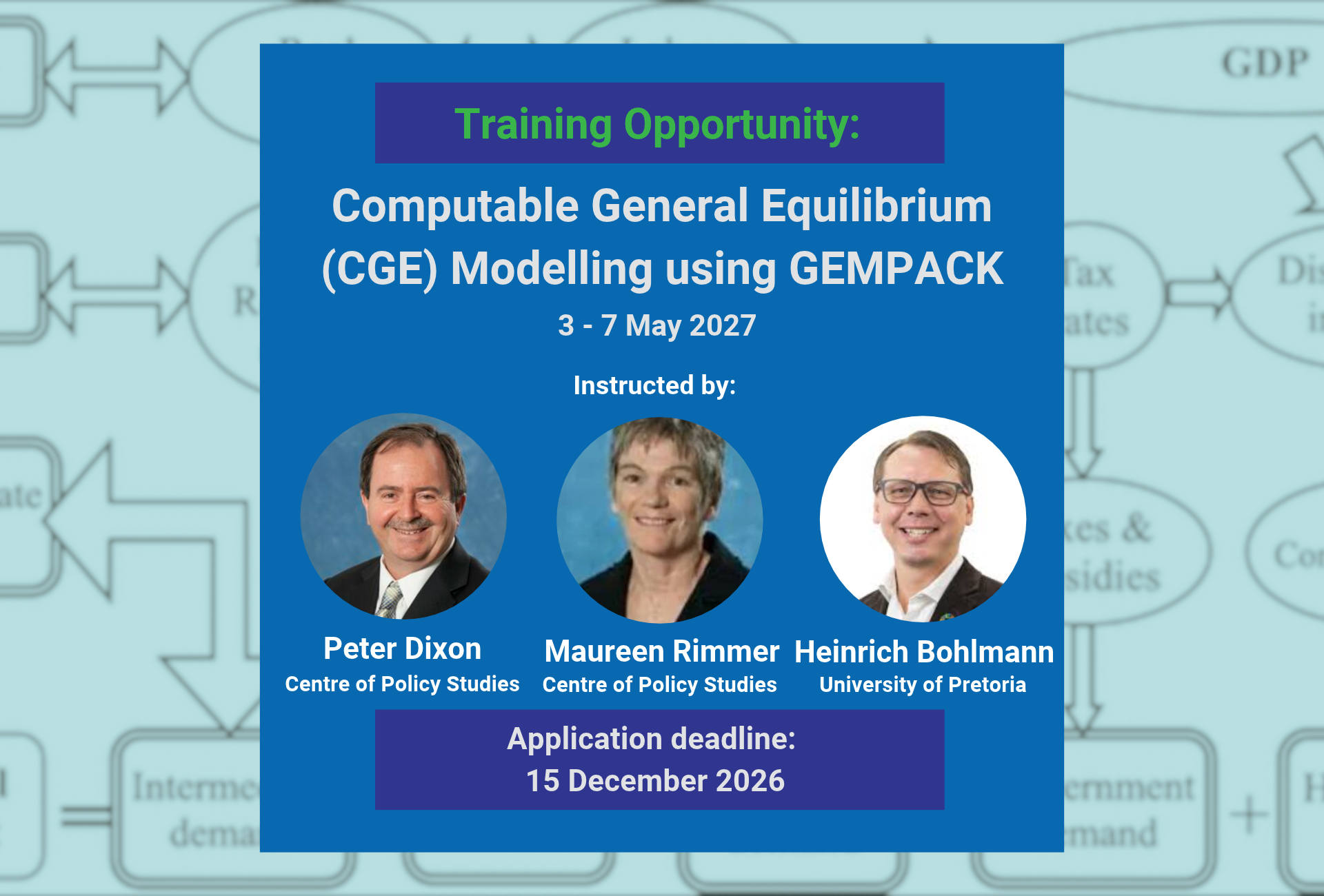
This one-week short course aims to introduce students and practitioners familiar with economy-wide modelling techniques to more advanced techniques in computable general equilibrium (CGE) using the latest GEMPACK solution platform. The course will be based around a dynamic single-country CGE model for South Africa developed by researchers at the University of Pretoria and the Centre of Policy Studies (CoPS) in Melbourne.
The first day, facilitated by Prof. Heinrich Bohlmann, will include an introduction to GEMPACK, installation and preparation of all training course software and models, and a review of the basic features of CGE modelling in the context of other modelling methodologies. The next four days, facilitated by Prof. Peter Dixon and Prof. Maureen Rimmer, will include a series of lectures and hands-on exercises designed to lift the practical policy modelling skills of participants to a more advanced level. Topics that will be covered throughout the week include i) foundations and history of CGE, ii) database construction, iii) theoretical structure, iv) model closure options, v) baseline simulations, vi) policy simulation design and implementation of shocks, vii) interpretation of simulation results, viii) model validation strategies, and ix) other advanced applications and recent innovations in CGE modelling.
The course will conclude with group projects and presentations during which participants will get the opportunity to work on real-world policy issues while learning about the intricacies of CGE modelling as well as presenting results in a clear and convincing manner. Active feedback from facilitators will ensure participants will be able to overcome any challenges and also take lessons from the week forward into their own research and policy modelling work.
Facilitators
Prof. Peter Dixon is known internationally for his work in CGE modelling and has been a pioneer in both single-country and global models for over 50 years. He is the principal author of the ORANI (1982) and MONASH (2002) books on CGE modelling published in the North-Holland Contributions to Economic Analysis series and was co-editor of Elsevier’s Handbook of CGE Modeling (2013). Prof. Dixon was awarded his PhD in Economics by Harvard University in 1972, with his thesis also published in the Contributions series. On top of his many other awards and accolades, he was appointed Officer in the Order of Australia in 2014. He continues his work today as Principal Researcher in the Centre of Policy Studies, building on his publication list of over 250 articles and 10 books.
Prof. Maureen Rimmer is the co-developer of the MONASH and USAGE models with Prof. Dixon and has published over 100 articles across mathematics and economics journals and edited volumes. Prof. Rimmer has been instrumental in the development, application, and documentation of dynamic CGE models at CoPS over the last 25 years, with contributions spanning a broad range of technical and policy-related topics. Prof. Rimmer was awarded her PhD in Mathematics by La Trobe University in 1978 and continues her work today as Professor in the Centre of Policy Studies.
Prof. Heinrich Bohlmann is the co-developer of the current University of Pretoria General Equilibrium Model (UPGEM) and has collaborated both locally and internationally on over 50 publications and projects involving CGE modelling. Prof. Bohlmann was awarded his PhD in Economics by Monash University in 2011 and continues his work today as Associate Professor in the Department of Economics at the University of Pretoria.
Target Participants and Prerequisites
This training course is intended for PhD candidates, postdoctoral researchers, early-career academics, and research professionals at economic policy institutions interested in practical policy analysis. Master’s students with strong quantitative backgrounds may also be considered. Applicants should have previous working experience with CGE models or other economy-wide modelling methods, and a keen interest in learning more about state-of-the-art CGE methods. All participants must have their own Windows-based laptop with administrator rights (Apple laptops will require Parallels in order to install the required GEMPACK software), a high degree of computer literacy, and basic knowledge of computer programming.
Application Process and Requirements
Applications must be submitted by 15 December 2026. Decisions will be communicated by 15 January 2027.
Funding and Logistics
ERSA will cover domestic travel within South Africa and accommodation for participants based at South African institutions for the duration of the course.
Places are limited to 18 participants. Funding and participation decisions remain at the discretion of the organisers.
Contact
For more information and registration details, please contact Fouché Venter.