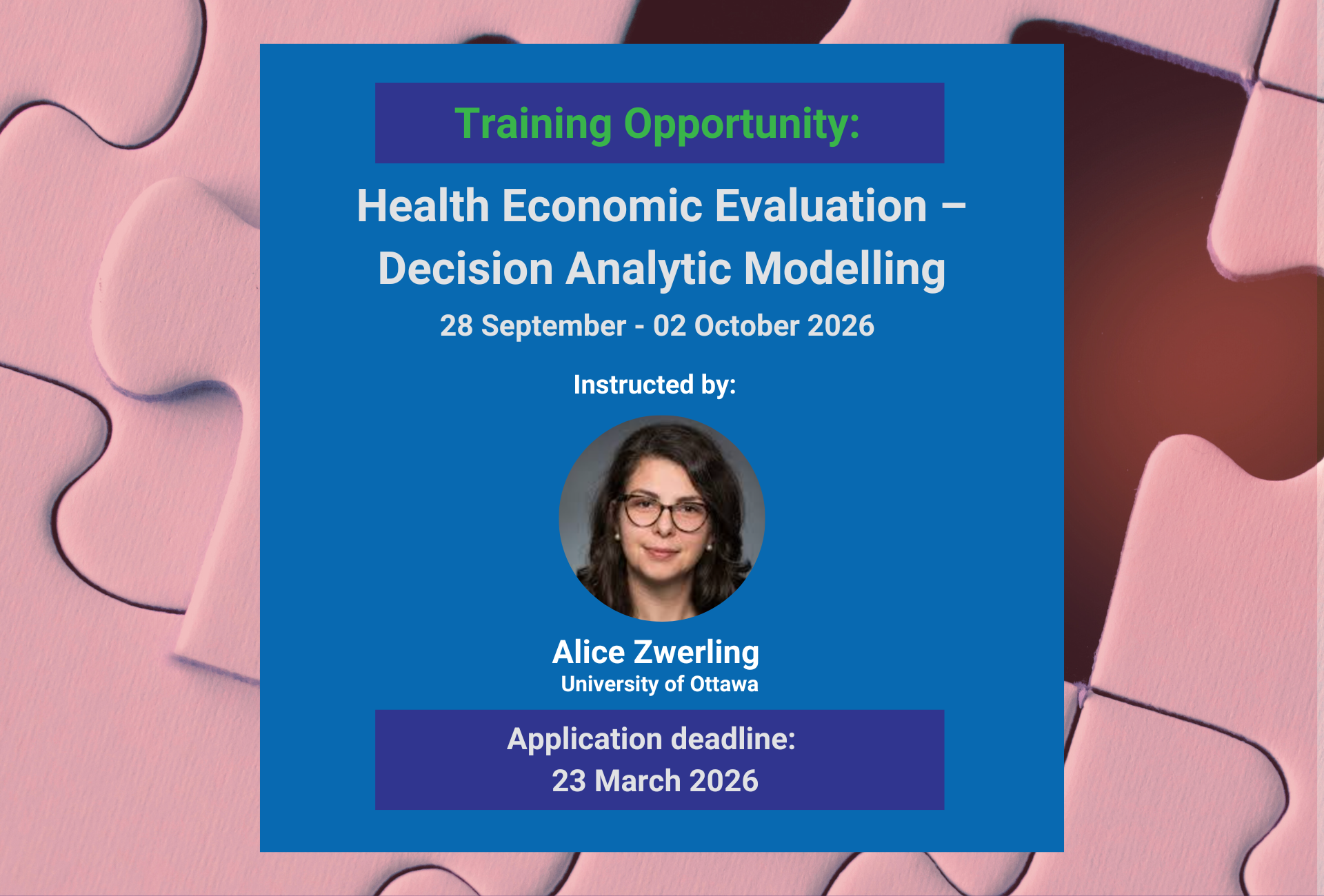
Economic Research Southern Africa (ERSA) invites applications for a five-day intensive skills workshop on decision analytic modelling in health economic evaluation. The course focuses on practical methods for building and applying economic evaluation models to inform health policy and priority setting.
Course overview
The primary goal of this workshop is to equip participants with the skills required to develop economic evaluation models that address real-world health policy questions. The course introduces key concepts in economic evaluation and modelling, with a strong emphasis on hands-on application.
Formal lectures in the morning sessions will cover the theoretical foundations of economic evaluation, decision analysis, sequential analysis, and Markov modelling. These sessions will be complemented by practical exercises using Excel and R, allowing participants to build and interpret economic evaluation models. Familiarity with excel is assumed, but no previous exposure to excel macros or R software is necessary as students will be guided through the use of these approaches in a step by step manner.
During afternoon sessions, participants will work in small groups to develop a policy-focused economic modelling proposal. This includes formulating a decision problem, designing an appropriate model structure, selecting modelling approaches, and identifying key parameters. Group proposals will be presented on the final day for discussion and feedback.
Assumed prior knowledge
The workshop is designed for participants with an interest in health economic evaluation, including graduate students, public health professionals, and policymakers.
A formal background in health economics is not required. However, familiarity with introductory concepts in biostatistics and epidemiology—such as study designs and measures of disease burden, such as incidence and prevalence—will be beneficial. Basic quantitative skills are assumed.
Course outline
This five-day intensive workshop provides participants with a practical introduction to economic evaluation and decision-analytic modelling for health policy analysis. The course begins by introducing the foundations of economic evaluation and sequential analysis, with a focus on how these methods inform policy choices and priority setting. Participants are then guided through the development of decision analysis models, including the incorporation of disease natural history, effectiveness evidence, costs, and health outcomes. The workshop also introduces Markov modelling techniques and discusses key methodological considerations such as uncertainty analysis, sensitivity analysis, and advanced modelling issues. In addition, participants are exposed to budget impact analysis and its role in programme planning and policy decision-making. Throughout the course, theoretical lectures are complemented by hands-on exercises using Excel and R, and participants work in small groups to develop and present a policy-focused economic modelling proposal, receiving feedback from peers and the instructor.
Instructor
Dr Alice Zwerling is a health economist specialising in tuberculosis (TB) and the use of economic evaluation to inform health policy. She holds a PhD in Epidemiology from McGill University and completed postdoctoral training in health economic evaluation at the Johns Hopkins Bloomberg School of Public Health. Prior to joining the University of Ottawa, she worked with the KNCV Tuberculosis Foundation in The Hague, providing technical support to national TB programmes through the USAID-funded Challenge TB programme. Dr Zwerling is currently an Associate Professor in the School of Epidemiology and Public Health at the University of Ottawa. Her research focuses on the cost-effectiveness of diagnostics, screening strategies, and preventive treatments, using economic modelling to assess the impact of scaling up new health technologies.
Target Participants
The workshop is open to Masters Students, PhD Candidates, Early- or Mid- career researchers and public health professionals and policy makers. Applicants should demonstrate an interest in health policy, economic evaluation, or applied health research.
Application Process and Requirements
Interested applicants must submit their application by 23 March 2026. Application decisions will be communicated by 6 April 2026.
ERSA will cover domestic travel (within South Africa) and accommodation costs for participants based at South African institutions. For students based in outside of South Africa, ERSA will cover accommodation and domestic travel within South Africa, while international flights will be the responsibility of the participant.
Places are limited to 25 participants, and funding to attend the workshop is entirely at the discretion of the organisers.
Contact
For more information and registration details, please contact Claudine Tshabalala.