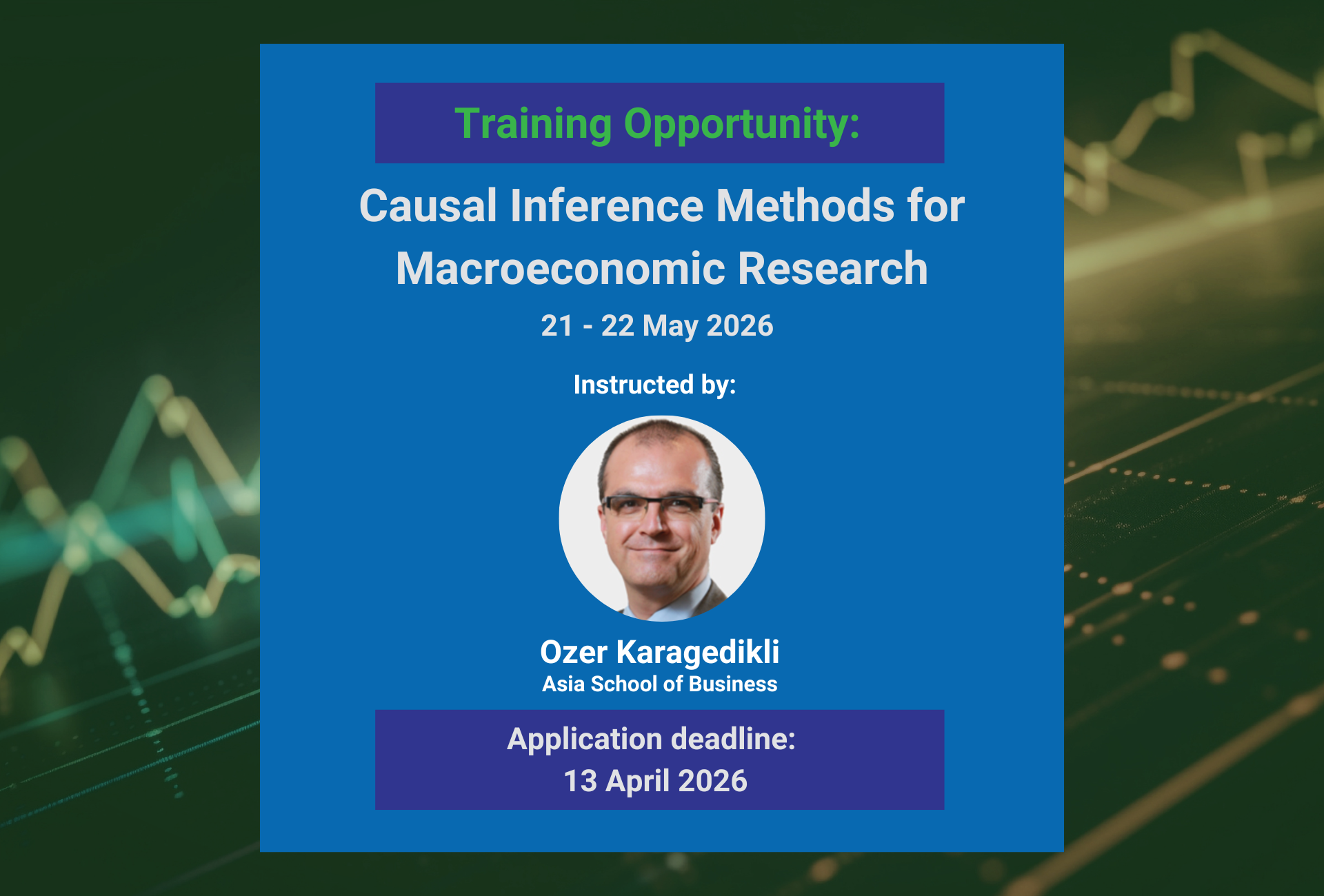
Economic Research Southern Africa (ERSA) invites applications for an intensive, intermediate-level workshop on causal inference methods tailored to macroeconomic policy analysis.
Course overview
Modern macroeconomic and policy questions are inherently causal. Policymakers and central banks routinely ask:
- What is the impact of oil price shocks on inflation and output?
- How do macroprudential tools – such as Loan-to-Value (LTV) limits – affect credit dynamics?
- What are the transmission channels of monetary policy to exchange rates and financial markets?
Answering such questions requires careful empirical design beyond simple correlations. This course provides a structured and applied introduction to state-of-the-art causal inference techniques, with a strong emphasis on macroeconomic and financial applications. Participants will engage with both foundational methods and recent empirical approaches used in leading academic and policy research.
Course outline
The workshop covers the core causal inference toolkit as applied to macroeconomic research, drawing on influential studies published in top economics journals.
The course will cover the following core methodologies:
- Potential Outcomes Framework and Randomized Controlled Trials (RCTs)
- Instrumental Variables (IV)
- Difference-in-Differences (DiD)
- Regression Discontinuity Design (RDD)
- High-Frequency Event Studies, particularly in monetary policy analysis
Each topic will be illustrated with applications from the macroeconomic literature, including central banking use cases.
Facilitator
Ozer Karagedikli is a Professor of Practice at Asia School of Business. He joined Asia School of Business in January 2022 after three years with the Southeast Asian Central Banks Research and Training (SEACEN) Centre in Kuala Lumpur where he was a senior economist. At Asia School of Business he teaches research methods, data analytics, and contemporary issues in macroeconomics. He also delivers related executive education courses, which can also be customized on demand. Prior to moving to Malaysia, he had been a central banker for 17 years. He worked as an economic adviser in research, modelling, and forecasting teams of the Reserve Bank of New Zealand (RBNZ).
He also had a stint at the Bank of England’s International Economic Analysis Division between 2008 and 2009. In addition to his role as an adviser at the RBNZ, he served as the secretary to the Monetary Policy Committee in 2003-2004, managed the External Research Network Initiative (ERNI), and served as the editor of the RBNZ Discussion Paper Series. He also served as a council member of the New Zealand Association of Economists (NZAE), a standing committee member of the Australasian Branch of Econometrics Society (ESAM), an associate editor for the Journal of Economic Surveys, and as a board member for the Orchestra Wellington. He organized/co-organized several conferences, workshops, courses and conference sessions, as well as policy meetings.
In 2014 he co-edited the special issue of the International Journal of Central Banking with John Williams and Gunes Kamber. In 2017, he spent a semester as a visitor at Bilkent University in Ankara. He completed his studies at Victoria University of Wellington in New Zealand. Ozer’s research interests are in the area of macroeconomics, monetary economics, forecasting, international linkages, housing and labour markets. His latest work includes forecast combinations for asymmetrically distributed variables, the effects of different types of forward guidance, housing supply and population growth, the role of job-to-job transitions and wage growth, and the role of different types of credit.
Target Participants
The workshop is intended for PhD candidates, postdoctoral researchers, early-career academics, and research professionals at central banks and related policy institutions. Advanced Master’s students with strong quantitative backgrounds may also be considered.
Applicants should have:
- Prior graduate-level exposure to econometrics and quantitative methods.
- Working familiarity with R or Stata (R will be used in workshop exercises).
- A research interest in empirical macroeconomics or central bank policy analysis.
Application Process and Requirements
Applications must be submitted by 13 April 2026. Decisions will be communicated by 17 April 2026.
Funding and logistics
ERSA will cover domestic travel (within South Africa) and accommodation for participants based at South African institutions. For participants based outside South Africa, ERSA will cover accommodation and domestic travel; international flights remain the participant’s responsibility. Places are limited to 25 participants. Funding decisions remain at the organisers’ discretion.
Contact
For more information and registration details, please contact Claudine Tshabalala.