When they can’t scale, the economy can’t grow
This economic note was published in Currency News on 19 March 2026
According to the OECD’s 2025 Economic Survey of South Africa, our economy-wide product market regulation is more restrictive than China, Brazil, Indonesia, Mexico, Türkiye, or any OECD country. South Africa is far from international best practice in 13 of the 15 indicators that make up the index.
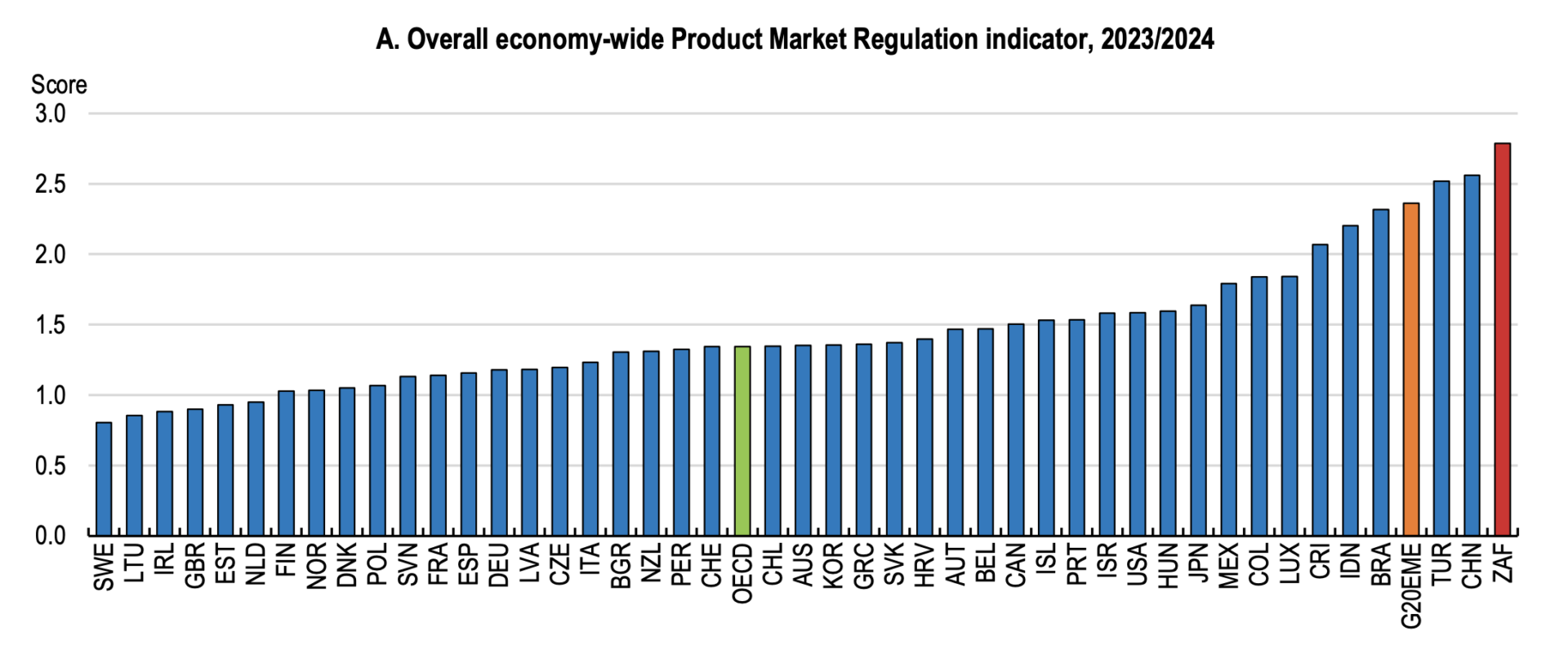
This alone should be cause for alarm. But its implications run much deeper than the budget, interest rates, and the big-ticket structural reforms of Operation Vulindlela that tend to dominate the public discourse. As The Economist recently noted: ‘To understand why countries grow, look at their firms.
But South Africa presents an interesting puzzle. Using firm-level data, a 2025 research paper by Justin Visagie, Ivan Turok, and Andrew Nell found that our firm churn is comparable to many developed countries. Yet, this constant entry and exit is not translating into economic growth as Joseph Schumpeter’s theory of creative destruction would predict.
Why not? Because South Africa lacks a functioning firm pipeline – one in which small firms grow into medium-sized firms, new entrants scale into significant competitors, and workers transition from low-productivity to high-productivity employment. What Visagie, Turok, and Nell find is not creative destruction but, as they term it, “simple reshuffling”. As a result, we get a “missing middle”.
Research presented at ERSA’s and the SARB’s recent Growth Conference provided some clarity on the puzzle. Instead of this functioning firm pipeline, industries in South Africa tend to be characterised by small groups of large, productive incumbents alongside a vast number of small firms entering and exiting without ever scaling or adding significant value. The pattern appears consistently across sectors. In manufacturing, the top 20 firms account for over 30% of sector income. In agriculture, 6.5% of commercial farms generate two-thirds of farm income. The export structure is highly concentrated too, with the top 5% of exporters accounting for a disproportionately large share of export value compared with peer economies.
One of the most compelling explanations is what economists describe as a diffusion failure. South Africa’s binding constraint is not the absence of productive firms or frontier technologies, but the failure of knowledge, technology, and innovation to spread across the broader economy.
Firm-level research shows persistently wide and non-converging productivity gaps: low-productivity firms are not catching up with high-productivity firms, and smaller high-productivity firms are not scaling sufficiently. In many countries, foreign investment sparks innovation that spreads across entire industries. In South Africa, the benefits remain trapped among firms already integrated into global supply chains. Even labour mobility, which should carry knowledge across the economy, generates productivity gains only at the very top of the market. The firms best positioned to benefit from knowledge diffusion are those that need it least, while the broad base of less productive firms remains cut off from the ideas and practices that could transform their performance.
The causes of the missing middle are interacting – infrastructure costs, weak competition, spatial mismatch, and regulatory burden all play a role. But the regulatory environment, and its role in suppressing diffusion, emerges as a central thread.
Excessive or poorly designed regulation suppresses firm growth, limits competition, and allows less productive incumbents to retain disproportionate market power. Yet young and growing firms are precisely the vehicles through which new technologies enter the economy and the primary drivers of net job creation. When these firms cannot enter or scale, the growth potential of the entire economy suffers.
The barriers that prevent a citrus farmer from exporting through Cape Town port overlap substantially with those that prevent a township developer from scaling a rental housing business, those that prevent a small manufacturer from becoming a medium-sized exporter, and those that prevent a productive firm from attracting the labour and capital it needs to expand.
This message is not unique to the Growth Conference. The IMF recently made a similar point in a blog on South Africa’s growth prospects, noting that to unlock growth and stimulate private investment, “additional broad-based reforms are essential to further improve the business environment”. Operating a business in South Africa, especially navigating licensing and permitting requirements, remains significantly more burdensome, fragmented, and costly than in many peer economies.
The policy implication is twofold. Innovation policy should place greater emphasis on the diffusion of existing technologies rather than solely on pushing the frontier – reducing the fixed costs and risks of adoption, providing the environment conducive to domestic firms upgrading their production processes, and aligning skills development with technology absorption. And with researchers, the OECD, and the IMF increasingly aligned, there is an opportunity to complement South Africa’s macroeconomic reform agenda with a sharper focus on the environment in which firms enter, compete, and scale.
Regulation is necessary. But when it is misguided, misplaced, and excessive, it is not protecting the economy. It is preventing one from emerging.