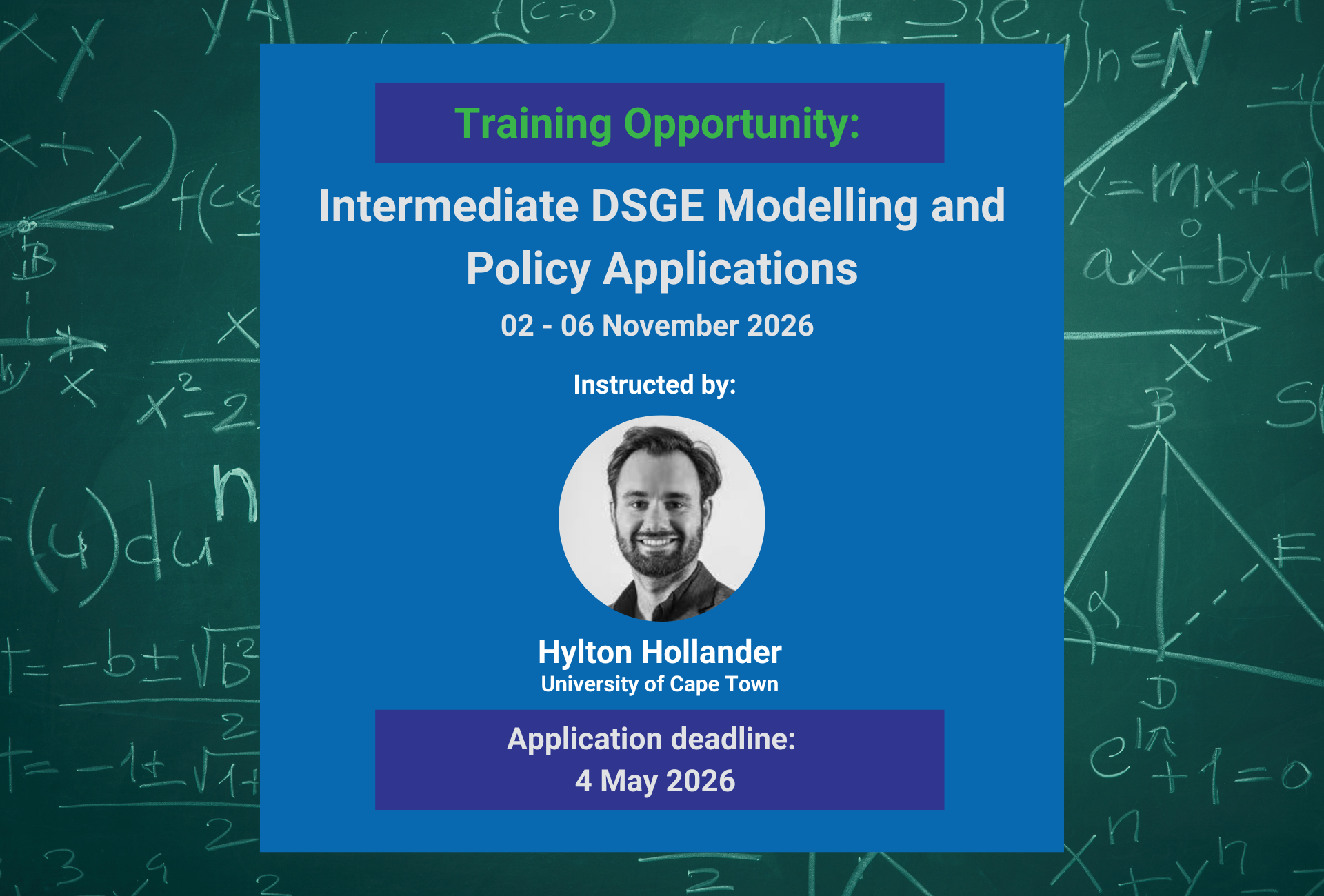
Economic Research Southern Africa (ERSA) invites applications for an intensive, intermediate-level workshop on Dynamic Stochastic General Equilibrium (DSGE) modelling and policy applications.
Course overview
DSGE models remain central to modern macroeconomic research and policy analysis. Many researchers have theoretical exposure to these frameworks, but fewer have practical experience building, extending, estimating, and interpreting models in ways that directly advance research and policy work.
This five-day workshop is hands-on, with emphasis on implementation, simulation, policy analysis, and (where appropriate) estimation in Dynare with MATLAB (GNU Octave is a viable free alternative). Participants will work through structured examples and apply methods to their own research models, with the goal of measurable progress during the week.
Course outline
The workshop covers the full DSGE modelling pipeline: model specification, calibration, steady-state computation, solution, simulation, diagnostics, policy experiments, and interpretation of results.
- Foundations and workflow setup
Participants build baseline growth models (including Solow and Ramsey-Cass-Koopmans) in Dynare and work through deterministic and stochastic simulations, including fiscal policy experiments. - RBC models and policy application
Sessions move from social-planner to competitive-equilibrium setups, then to technology shocks, business-cycle dynamics, and extensions with fiscal policy and simple public debt dynamics. Practical work introduces sensitivity analysis, moment matching, and key estimation/identification concepts. - New Keynesian models and monetary policy
Participants progress from flexible-price benchmarks to canonical New Keynesian structures, focusing on nominal rigidities, policy transmission, and alternative monetary rules. Practical sessions emphasise producing and interpreting impulse responses and policy counterfactuals. - Welfare, optimal policy, and estimation
Participants apply welfare-based policy evaluation, compare simple policy rules, and set up measurement equations for Bayesian estimation in Dynare, with attention to identification and robustness checks. - Consolidation and participant projects
Final sessions are dedicated to model refinement, short participant presentations, and structured feedback on implementation, documentation, and replication practices.
Preparatory materials and readings will be shared in advance.
Instructor
Prof Hylton Hollander is a macroeconomist at the University of Cape Town with research expertise in DSGE modelling, monetary and fiscal policy, and macro-financial linkages. He holds a PhD in Dynamic Macroeconomics and has published in leading applied macroeconomics and finance journals. He is a Council Member of the Economic Society of South Africa (ESSA) and is a convenor of ERSA’s Monetary and Fiscal Policy Research Programme.
Target Participants
The workshop is intended for Master’s students, PhD candidates, postdoctoral researchers, early-career academics, and policy professionals in economics or finance.
Applicants should have:
- Prior graduate-level exposure to macroeconomics and quantitative methods.
- Working familiarity with MATLAB or GNU Octave (prior Dynare use is helpful but not required).
- A research topic or policy question they can engage with during practical sessions.
Application Process and Requirements
Interested applicants must submit their application by 4 May 2026. Application decisions will be communicated by 18 May 2026.
Funding and logistics
ERSA will cover domestic travel (within South Africa) and accommodation costs for participants based at South African institutions. For students based outside of South Africa, ERSA will cover accommodation and domestic travel within South Africa, while international flights will be the responsibility of the participant.
Places are limited to 15 participants. Funding decisions remain at the organiser’s discretion.
Contact
For more information and registration details, please contact Claudine Tshabalala.