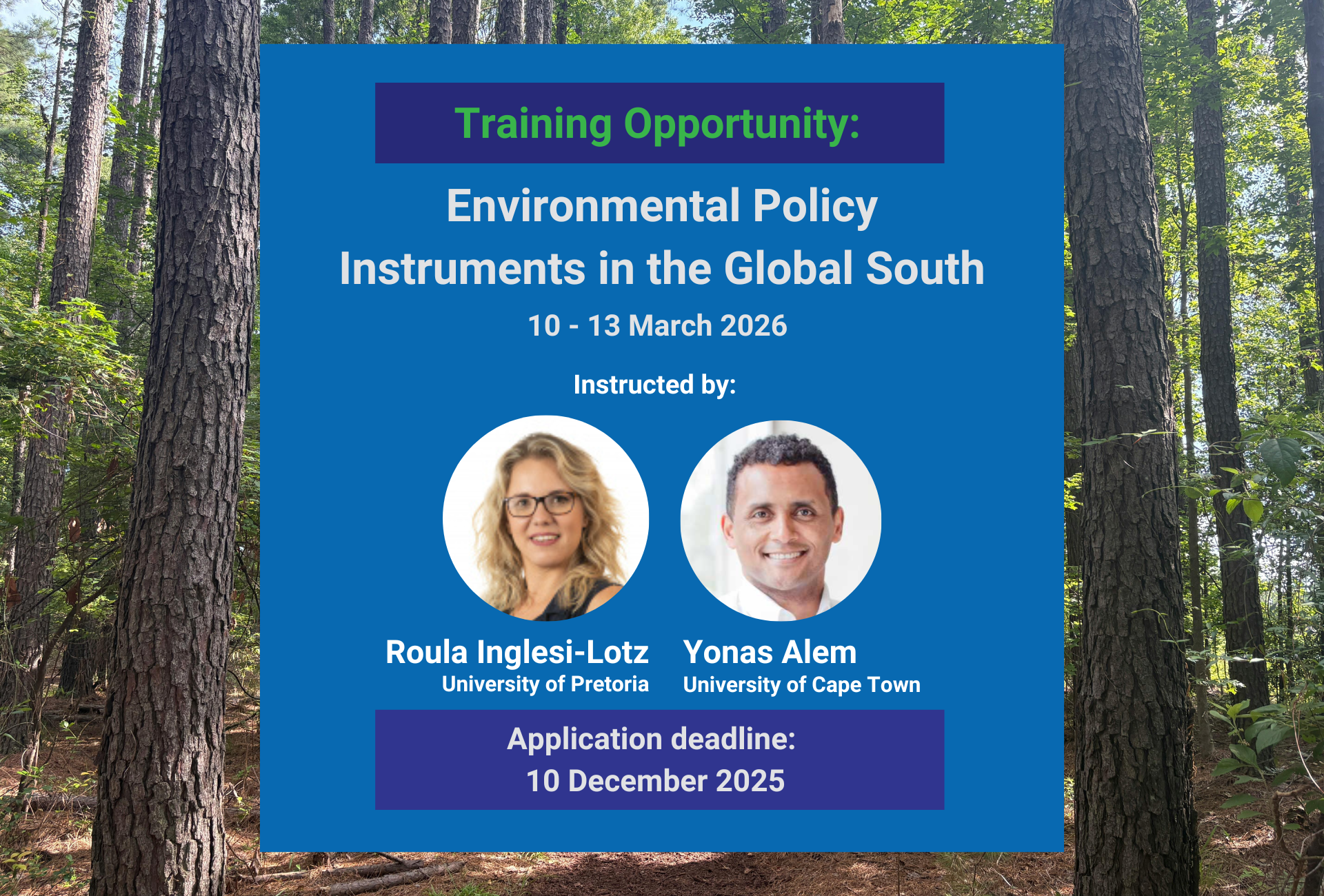
Economic Research Southern Africa (ERSA) invites applications for a skills workshop on the theoretical foundations of environmental externalities and policy responses, instructed by Prof. Roula Inglesi–Lotz, University of Pretoria, and Prof. Yonas Alem, University of Cape Town.
Delivered over four days, the course will equip participants with cutting-edge analytical tools to evaluate and design environmental policy instruments (EPIs) suitable for the Global South contexts.
Course objectives
By the end of the course, students will be able to:
- Understand the theoretical foundations of environmental externalities and policy responses.
- Critically assess various environmental policy instruments (EPIs) in the context of developing countries.
- Evaluate empirical evidence on the effectiveness, efficiency, and equity of EPIs.
- Design policy-relevant research questions and identify appropriate empirical strategies for evaluating EPIs.
Each training day will follow a consistent structure: the first session introduces key concepts and theory, followed by applied discussions that connect ideas to the Global South contexts.
Course outline (Tentative)
Days 1-2: Foundations and Instruments of Environmental Policy in the Global South
Instructor: Prof Roula Inglesi-Lotz
Objective: To equip participants with a strong theoretical grounding in environmental externalities, policy rationales, and key regulatory instruments, with a specific focus on how institutional capacity, governance, and real-world constraints shape environmental policy design and effectiveness in the Global South.
Session 1: Foundations of Environmental Policy
- Environmental externalities and market failures
- Pigovian rationale for intervention
- Property rights, Coase theorem, and challenges in low-institutional-capacity contexts
- Overview of environmental degradation patterns in the Global South
Session 2: Policy approaches: Command-and-control vs. market-based instruments
- Comparative theory and mechanisms: standards, taxes, tradable permits
- Institutional and enforcement prerequisites for implementation
- Discussion: what works where? (Case examples from Africa, Latin America and Asia)
Session 3: Cap-and-Trade and Permit Markets
- Theoretical foundations of emissions trading systems
- Design issues: cap setting, allocation, enforcement, leakage
- Lessons from pilot ETS systems
Days 3-4: Environmental Taxation, Behavioural Tools, and Climate Policy Implementation
Instructor: Prof Yonas Alem
Objective: To deepen participants’ understanding of fiscal, behavioural, and institutional approaches to environmental management, and to explore how countries can design and implement effective climate mitigation and adaptation strategies aligned with national development priorities.
Session 4: Pollution Taxes and Subsidy Reforms
- Design and implementation of Pigouvian taxes
- Political economy of environmental taxation and reform resistance
- Case studies: fuel subsidies and carbon tax experience in developing countries
Session 5: Behavioural, Informational, and Institutional Instruments
- Norm-based, informational, and behavioural interventions (“nudges”)
- Role of governance and anti-corruption in environmental enforcement
- Institutional coordination and compliance monitoring
Session 6: Climate Change, Adaptation, and Mitigation Policy in Practice
- Climate change as a global public-good problem
- Economics of adaptation and mitigation
- Integrating climate policy with development and equity goals
- Discussion: Nationally Determined Contributions (NDCs) and policy coherence in Africa
The course places strong emphasis on hands-on learning through discussions, debates, and practical exercises woven into each session. Participants will engage actively with real-world policy challenges, work in small groups to analyse case studies, and debate the merits of different environmental policy instruments. These interactive components are designed to encourage critical thinking, peer learning, and the practical application of concepts to participants’ own research or policy contexts.
Instructors
Yonas Alem is a Research Professor (Principal Research Officer) at the School of Economics, University of Cape Town, and Director of Capacity Building at the Environment for Development (EfD) initiative. He is also affiliated with the Abdul Latif Jameel Poverty Action Lab (J-PAL) at MIT.
He received his PhD in Economics from the University of Gothenburg, where he also served as an Associate Professor of Economics until September 2025. His research lies at the intersection of development, environmental, and behavioural economics, with a particular focus on risk and shocks, energy and climate, technology adoption, preference formation, and poverty dynamics in developing regions of Africa and South Asia. His empirical work primarily employs panel data econometrics and large-scale randomised controlled trials, and his findings have been published in several leading peer-reviewed international journals.
Prof. Alem has taught a range of graduate courses, including Advanced Panel Data Econometrics (PhD), Causal Inference and Impact Evaluation (PhD), Development Economics (PhD), and Academic Writing and Research Ethics (PhD) at the University of Gothenburg and several other universities. He has also supervised numerous PhD students, mentored early-career research fellows, and secured multiple multi-million-dollar research grants.
Roula Inglesi-Lotz is a Professor in the Department of Economics at the University of Pretoria and the DSI/NRF SARChI Chair in Just Energy Transition — a bilateral collaboration between the University of Pretoria (South Africa) and RWTH Aachen University (Germany). A dedicated teacher and mentor, she leads courses in energy and environmental economics, econometrics, and development, guiding students to connect economic theory with real-world sustainability challenges.
Her research spans energy, environment, and economic development, with over 100 peer-reviewed publications and contributions to international handbooks and reports. She is an NRF-rated researcher (C1) and recipient of the SANEA Upliftment through Education Award (2024) and the Distinguished Young Woman Researcher Award (2017). Internationally, she serves as Vice President for Membership and Regional Relations of the International Association for Energy Economics (IAEE) and sits on editorial boards of leading journals, including Energy Economics, Energy Policy, and Economics of Energy and Environmental Policy.
Target Participants
This course is targeted towards graduate economics students and early career researchers and policymakers with prior training in microeconomics and econometrics.
Application Process and Requirements
Interested applicants must submit their application by completing the Application Form below, by 10 December 2025. Application decisions will be communicated by 17 December 2025.
ERSA will cover domestic travel and accommodation costs for participants based at South African institutions. Places are limited to 30 participants, and funding to attend the workshop is entirely at the discretion of the organisers.
Contact
For more information and registration details, please contact Yoemna Mosaval.